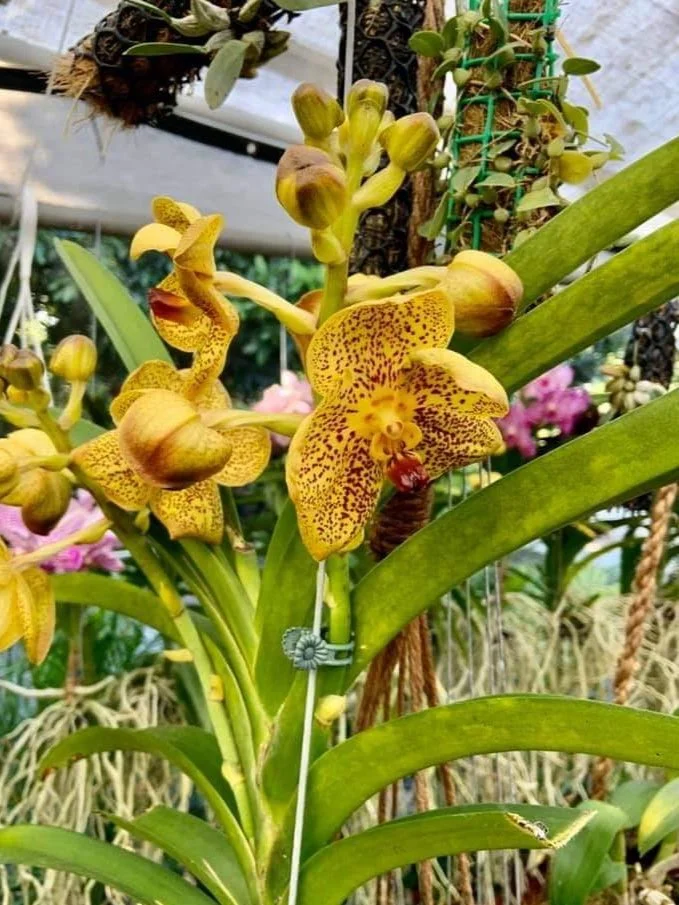
Vanda Orchids: A Magnificent Species – Care and Growing Guide

The Queen of Orchids
The Vanda Orchid is one of the world's most admired orchid species, prized for its extraordinary ornamental value, impressive size, spectacular blooms, and unmistakably exotic silhouette. With proper care, these remarkable plants can live for 15 to 20 years and grow to astonishing dimensions. Several specimens in my own collection exceed 200 cm (6.5 ft) in length. In this guide, I'll introduce you to the fundamentals of growing and caring for these exceptional orchids.
The Vanda Orchid is highly sought after for its dramatic appearance and elegant growth habit. Native to the tropical regions of Asia, Vandas feature a unique structure with exposed aerial roots that absorb both moisture and nutrients directly from the surrounding air. Most varieties produce large, long-lasting flowers in stunning shades of purple, pink, yellow, blue, violet, and white, often remaining in bloom for several weeks. These orchids thrive in warm temperatures, abundant humidity, and bright light, making them ideal for tropical climates or carefully controlled indoor environments. Beyond their spectacular beauty, Vanda orchids are also valued for their longevity and ease of propagation.

As tropical plants, I strongly recommend growing them indoors for much of the year unless you live in a consistently warm climate. Their natural habitat provides valuable clues about their care, as Vandas are particularly sensitive to sudden temperature fluctuations and changes in humidity.
Vandas are slow-growing orchids that require bright, abundant light, while still being protected from harsh direct sunlight during the hottest hours of the day. They also have relatively high water requirements, particularly during the warmer months.
Unlike many other orchids, Vanda orchids are entirely aerial plants. Their long, robust roots are exposed to the air and covered with tiny pores that efficiently absorb water and nutrients. These roots are both extensive and abundant, supporting plants that can reach impressive sizes. Vandas do not develop pseudobulbs; instead, their flower spikes emerge directly from the central stem between the leaves. A single flower spike can produce more than 15 blooms, creating a truly spectacular display.

As with many orchid species, one of the key factors that encourages flower spike development is the difference between daytime and nighttime temperatures. This natural fluctuation typically occurs during winter, with flowering following several months later. Under optimal conditions, Vanda orchids may bloom more than once each year, and many varieties produce a delicate, pleasant fragrance.
If you grow Vanda orchids at home, providing the right balance of light and humidity is essential. While some varieties tolerate direct sunlight, they require considerably more frequent hydration under those conditions. Ideally, they should be displayed hanging in a covered outdoor porch, greenhouse, or bright indoor gallery with large windows and excellent air circulation.

As with many orchid species, one of the key factors that encourages flower spike development is the difference between daytime and nighttime temperatures. This natural fluctuation typically occurs during winter, with flowering following several months later. Under optimal conditions, Vanda orchids may bloom more than once each year, and many varieties produce a delicate, pleasant fragrance.
If you grow Vanda orchids at home, providing the right balance of light and humidity is essential. While some varieties tolerate direct sunlight, they require considerably more frequent hydration under those conditions. Ideally, they should be displayed hanging in a covered outdoor porch, greenhouse, or bright indoor gallery with large windows and excellent air circulation.

One of the most effective ways to water Vanda orchids is by immersing the entire root system in a large container of water for approximately 30 minutes. This allows the roots to absorb as much moisture as possible before draining completely. In their natural habitat, Vandas experience frequent, heavy tropical rainfall, making this soaking method one of the closest ways to replicate their natural growing conditions.
If you're passionate about orchids and would like to experience the joy of growing one of these extraordinary plants at home, in your garden, or even in your office, you'll find a wide selection of Vanda Orchids in a variety of stunning colors available through my shop.
My Vanda Orchids are carefully cultivated, fully acclimatized, and among the largest specimens available, typically measuring 130–190 cm (4.3–6.2 ft) in length. Most are offered in full bloom, with a wide range of beautiful colors, allowing you to enjoy their spectacular beauty from the very moment they arrive.
If you have any questions about caring for Vanda orchids or need advice on cultivation, feel free to leave a comment. I'll be happy to share additional tips and help you successfully grow these magnificent plants.